A steering failure at sea is not a maintenance inconvenience. It is a safety emergency. On a commercial vessel, loss of steering control puts the crew, the cargo, and the vessel itself at immediate risk. It can trigger collision, grounding, or an uncontrolled drift into shipping lanes. Classification societies, flag states, and port state control authorities all treat steering system integrity as a non-negotiable requirement for seaworthiness.
Yet hydraulic steering systems on commercial vessels fail regularly. They fail on fishing vessels pulling nets in the Southern Ocean. They fail on cargo ships transiting the Atlantic. They fail on offshore support vessels working in the North Sea and the Indian Ocean. The failures are rarely sudden or unpredictable. Most develop over time through wear, contamination, or deferred maintenance, and most give clear warning signs before they become critical.
This post covers how hydraulic steering gear works on commercial vessels, the specific components that fail and why, the warning signs a chief engineer should act on before they become serious, and what a correct steering gear service and repair involves.
How Hydraulic Steering Gear Works on a Commercial Vessel
Most commercial vessels use one of two hydraulic steering configurations: the ram type or the rotary vane type. Both use pressurised hydraulic fluid to convert a signal from the helm or autopilot into physical movement of the rudder.
In a ram steering system, one or more hydraulic cylinders, called rams, push directly against a tiller arm connected to the rudder stock. When the helmsman or autopilot calls for a course change, a hydraulic power unit drives fluid into the appropriate side of the ram, pushing the tiller and rotating the rudder. Returning fluid exits from the other side back to the reservoir. The size and number of rams varies with vessel size and the torque required to move the rudder under load at sea speed.
In a rotary vane system, a hydraulic motor with internal vanes rotates directly around the rudder stock. Pressurised fluid acts on the vanes to rotate the stock in the required direction. Rotary vane systems are compact, provide high torque, and are widely used on larger commercial vessels where deck space around the steering gear is limited.
Both systems include a hydraulic power unit with one or more pumps, a reservoir, filters, valves, pipework, and an autopilot or telemotor control circuit connecting the bridge to the steering gear room. Classification societies require redundancy in the power supply and often in the pump arrangement, so that a single component failure does not leave the vessel without steering.
The entire system operates under continuous demand whenever the vessel is underway. Unlike deck machinery that cycles on and off, steering gear is active for the full duration of every voyage. That continuous duty cycle makes component wear an inevitable reality, and it makes the maintenance interval for steering systems more critical than almost any other hydraulic application on the vessel.
The Components That Fail Most Often
Steering gear failures follow predictable patterns. The same components fail across vessel types and operating regions, and the causes are largely consistent regardless of where in the world the vessel operates.
Ram Seals and Cylinder Wear
The hydraulic rams in a steering system cycle continuously with every course correction the vessel makes. On a vessel transiting busy shipping lanes or operating in rough seas, that can mean thousands of ram movements in a single voyage. Ram seals are the most frequently replaced component in a steering system, and for good reason.
When a ram seal begins to fail, fluid bypasses internally from the high-pressure side to the low-pressure side of the cylinder. The ram loses force and the rudder becomes slow to respond or fails to hold position under lateral water pressure on the rudder blade. External seal failure shows as fluid weeping down the cylinder body. Either symptom requires immediate attention. A ram that is bypassing internally in rough conditions gives the helmsman or autopilot progressively less rudder authority as the fault develops.
Hydraulic Pump Wear and Failure
The steering gear pump delivers the pressure and flow the system needs to move the rudder at the required speed. As pumps wear, internal clearances increase and volumetric efficiency drops. The pump still moves fluid but delivers less pressure at a given flow rate. The first symptom is usually slower rudder response. Vessels with autopilots may see the autopilot hunting, making more frequent corrections and working harder to hold course because the rudder is not responding as quickly as the control system expects.
On vessels with a single steering pump, pump failure is a direct loss of steering. Most classification rules require a second pump that can be brought online manually or automatically. Regular pressure and flow testing of both pumps confirms they are meeting specification before the vessel is dependent on them at sea.
Relief Valve Drift
Steering gear systems include pressure relief valves that limit maximum system pressure and protect rams, hoses, and the pump from damage when the rudder meets an obstruction or when steering loads spike in heavy weather. These valves are set to a specific pressure during commissioning and are expected to hold that setting throughout their service life.
In practice, relief valves drift. A valve set at commissioning may be operating above or below its correct pressure setting after years of service without recalibration. A valve set too low restricts steering performance and causes the system to relieve pressure before the rudder reaches full movement. A valve set too high allows system pressure to exceed safe limits during heavy weather loads, stressing seals, hoses, and fittings that were not designed for those pressures. Neither condition announces itself loudly. Both are identified through pressure testing.
Fluid Contamination and Water Ingress
Hydraulic fluid in a steering system does more than transmit force. It lubricates the internal surfaces of the pump, seals the clearances between moving parts in control valves, and carries heat away from the pump and rams. Contaminated fluid stops performing all three of those functions effectively.
Water ingress is the most destructive contamination type in marine steering systems. It enters through reservoir breathers, degraded seals on the reservoir filler cap, and condensation inside the reservoir during temperature cycling. Water accelerates corrosion on internal metal surfaces, degrades the fluid’s additive package, reduces the film strength that protects pump components, and promotes microbial growth that generates sludge and blocks fine filters. A steering system running on contaminated fluid is underperforming and wearing faster than any service log will reflect. Regular oil sampling is the only reliable way to know the condition of the fluid in the system.
Control Valve and Solenoid Faults
The directional control valves that distribute fluid to the correct side of the steering rams are precision components. Contamination causes sticking and wear in valve spools. A valve that sticks partially open causes the system to creep, where the rudder moves slowly in one direction without a command from the helm or autopilot. A valve that sticks closed prevents rudder movement on one tack. Solenoid valves in electrically controlled steering systems are subject to corrosion and coil failure in the humid environment of a steering gear room.
Pipework, Hoses, and Fittings
High-pressure hydraulic pipework and hoses connect the power unit to the steering rams. On vessels that have been in service for many years, this pipework accumulates wear from vibration, pressure cycling, and corrosion at supports and fittings. Hoses in the steering gear room age from heat, ozone, and pressure fatigue. A hose failure in the steering gear room under working pressure creates a dangerous situation both from the fluid injection risk and from the immediate loss of steering control it causes.

Warning Signs Every Chief Engineer Should Act On
Steering gear failures almost always give warning before they become critical. The problem is that the warnings are easy to dismiss as normal vessel behaviour, particularly on older ships where gradual performance decline has become the accepted baseline.
Slow rudder response to helm or autopilot commands is the most common early warning. When a rudder that previously reached hard over in a given time now takes longer, the system is losing performance. The cause could be pump wear, relief valve drift, internal ram bypass, or a combination of all three. It should be investigated, not accepted.
Autopilot hunting, where the autopilot makes rapid, repetitive steering corrections that it did not previously need to make, indicates the steering system is not holding course as effectively as the autopilot expects. The autopilot is compensating for a hydraulic system that is underperforming. This is a common early sign of pump wear or internal ram bypass that is often misattributed to sea conditions or autopilot calibration.
Unusual noise from the steering gear pump or rams, including whining, knocking, or a change in the pitch of normal operating sounds, indicates a component under stress. Pump cavitation, bearing wear, and relief valve chatter all produce distinct sounds that an experienced engineer will recognise as different from normal operation.
Fluid temperature running higher than usual in the steering gear room points to the system working harder than it should, often because a relief valve is dumping fluid at low pressure and the pump is running continuously against that restriction.
Any external fluid leak from rams, hose ends, or fittings in the steering gear room requires immediate attention. A small leak in a high-pressure system under continuous duty will grow. Steering gear rooms are not always inspected as frequently as machinery spaces, and a leak that goes unnoticed for several days can result in a low fluid level that causes pump cavitation and accelerated internal damage.
What a Correct Steering Gear Service Involves
Steering gear maintenance on commercial vessels is governed by classification society rules and the vessel’s planned maintenance system. Most societies require steering gear to be inspected and tested at defined intervals, with records maintained in the vessel’s safety management system. What the rules require as a minimum and what good practice looks like are not always the same thing.
A thorough steering gear service starts with full system pressure testing. This means measuring pump delivery pressure and flow at both the working pressure setting and at relief pressure, testing the operation and calibration of all relief valves, checking for pressure loss across control valves, and verifying that the emergency steering arrangement works as designed and meets the speed-to-hard-over requirement specified by the classification society.
Ram inspection involves checking for external seal condition, measuring rod wear and surface condition, and testing for internal bypass by pressurising each side of the ram and monitoring for pressure decay. A ram that holds pressure correctly on both sides has seals and cylinder bore in acceptable condition. A ram that loses pressure is bypassing internally and requires seal replacement or, if the bore is scored, a full rebuild.
Fluid analysis should be part of every steering gear service. A fluid sample taken from the reservoir and sent for laboratory analysis gives an objective picture of contamination levels, water content, particle count, and the condition of the fluid’s additive package. This data tells you whether the fluid is fit for continued service, whether the filtration system is coping with the operating environment, and whether there are signs of internal component wear generating metal particles in the fluid.
All relief valves should be removed, bench tested against their specification, and recalibrated or replaced as required. A relief valve that cannot be set to the correct pressure on a test bench should be replaced rather than returned to service. The cost of a relief valve is insignificant against the cost of the damage an incorrectly set valve causes to the rest of the steering system.
Hose and pipework inspection covers the full hydraulic circuit from the power unit to the rams. Hoses are checked for age, external condition, and signs of fatigue at end fittings. Any hose that shows bulging, cracking, or external corrosion at the ferrule should be replaced as a matter of course. The age of hoses in the steering gear circuit should be tracked and hoses replaced at the manufacturer’s recommended service life regardless of visual condition.
Getting Steering Gear Repaired When a Vessel Calls at Cape Town
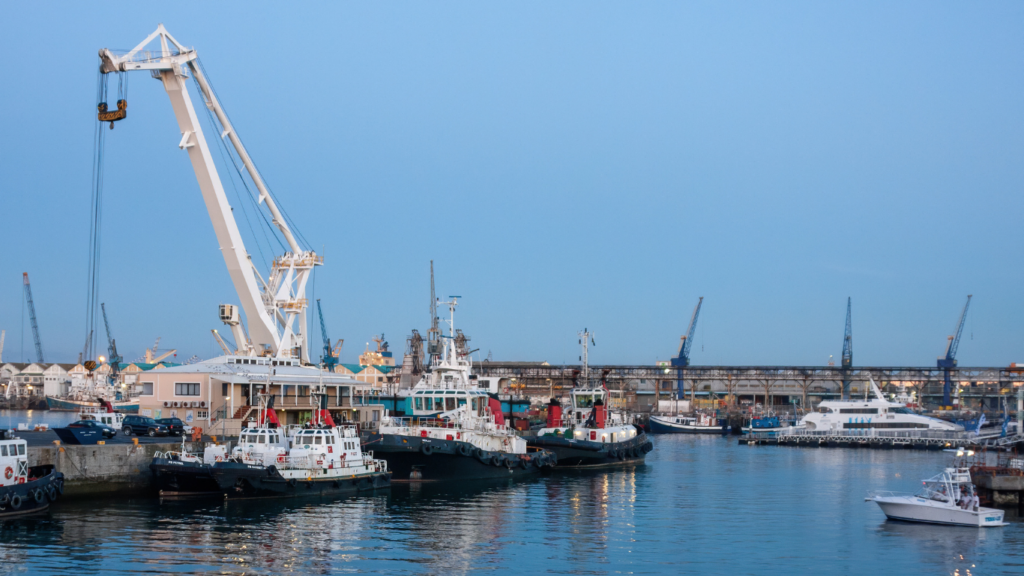
Cape Town is a significant port of call on international shipping routes. Vessels transiting between the Atlantic and Indian Oceans, fishing fleets operating in the Southern Ocean, offshore support vessels working along the West African coast, and cargo ships on African trade routes all call at Cape Town for fuel, provisions, crew changes, and maintenance.
For vessels arriving with a known steering gear fault, or for chief engineers who want a full steering system inspection completed during a Cape Town port call, fast turnaround is essential. Time in port has a cost, and delays waiting for parts or specialist technicians are not acceptable when a voyage schedule is at stake.
DMA Hydraulics and Pneumatic Solutions provides hydraulic steering gear diagnostics, pressure testing, ram seal replacement, pump repair, relief valve calibration, hose replacement, and fluid servicing for commercial vessels calling at Cape Town. We carry hydraulic components and seals for a wide range of steering gear configurations and can source replacement parts quickly for vessels requiring parts that are not in our standard inventory.
Our team works within the timeframes that vessel schedules allow. We understand that a vessel in port is not generating revenue, and we structure our work accordingly. Diagnosis is completed first, repair options are discussed with the chief engineer and owner’s representative, and work is carried out to get the vessel back to sea with a steering system that meets classification requirements and the vessel’s operational needs.
Frequently Asked Questions
What is the most common cause of hydraulic steering gear failure on commercial vessels?
Ram seal failure and pump wear are the most frequent causes. Both develop gradually through normal use and are identifiable through pressure testing and inspection before they cause a complete steering failure. Fluid contamination accelerates both failure types significantly.
How do I know if my steering gear is underperforming before it fails completely?
The most reliable indicators are slow rudder response to helm commands, autopilot hunting where the system makes repeated corrections it did not previously need, unusual noise from the steering pump or rams, and elevated fluid temperature in the steering gear room. Any of these warrants investigation.
How often should steering gear relief valves be tested and recalibrated?
Classification society rules specify minimum inspection intervals. In practice, relief valves should be bench tested at every planned maintenance interval and whenever pressure performance testing indicates the system is not reaching or is exceeding its working pressure specification. Valves drift over time and interval-based testing catches that drift before it causes damage.
Can a vessel operate safely with a known steering gear fault?
This depends entirely on the nature and severity of the fault. Minor performance degradation may not prevent safe operation in benign conditions, but any fault that affects rudder response, holding ability, or the availability of the emergency steering arrangement reduces the safety margin the system is designed to provide. Classification society rules and the vessel’s SMS should govern the decision. Most known faults should be repaired at the earliest opportunity.
What does a hydraulic steering gear pressure test involve?
A full pressure test measures pump delivery pressure and flow, verifies relief valve settings against specification, checks for pressure loss across control valves, and tests each ram for internal bypass by measuring pressure decay with the ram pressurised and the pump stopped. The test identifies underperforming components and gives the chief engineer objective data on system condition.
Can DMA Hydraulics carry out steering gear repairs on vessels in Cape Town on short notice?
Yes. We provide hydraulic steering gear diagnostics, repairs, and component replacement for commercial vessels calling at Cape Town. We understand that port turnaround times are tight and structure our work to minimise time alongside. Contact our team directly to discuss the scope of work and timeline before your vessel arrives.
How long does a full steering gear service take in port?
This depends on the system configuration and the scope of work required. A pressure test and inspection can typically be completed within a few hours. Ram seal replacement, pump work, and hose renewal depend on access and the components involved. Contact us with your vessel’s steering gear details and we can give you a realistic time estimate for the scope of work required.
Do Not Wait for a Steering Failure at Sea
Hydraulic steering gear gives clear warning before it fails completely. The warning signs are there in slower rudder response, autopilot behaviour, pump noise, and fluid condition. Acting on those signs during a scheduled port call costs a fraction of what an emergency repair at sea costs, and it protects the crew and vessel from the consequences of a steering failure underway.
If your vessel is calling at Cape Town and you want a steering gear inspection completed during your port call, or if you have a known steering system fault that needs diagnosis and repair, contact DMA Hydraulics and Pneumatic Solutions.
Our team carries out hydraulic steering gear diagnostics, pressure testing, ram service, pump repair, and component replacement for commercial vessels on international routes.