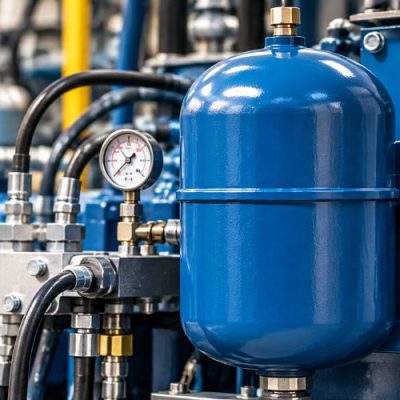
A hydraulic accumulator stores pressurised fluid so your system can use it when it needs it. It holds hydraulic fluid on one side and nitrogen gas on the other. When system pressure rises, fluid enters the accumulator and compresses the gas. When the system needs extra flow or pressure, the gas expands and pushes the fluid back into the circuit. Accumulators supply emergency power, absorb shock, smooth pressure pulses and make up for small leaks.
An accumulator works without moving parts that you can see, so many operators leave it unchecked until something stops working. A unit with the wrong precharge or a failed bladder cannot do its job, and the fault often appears somewhere else in the system, such as a pump that cycles constantly or a valve that hammers. An accumulator also holds stored energy after you switch the machine off, which means you must inspect it with care. This guide explains how accumulators work, how the main types differ, what the warning signs look like and why qualified technicians should carry out the inspection. It focuses on marine, offshore and industrial applications.
How an Accumulator Stores Hydraulic Energy
Hydraulic fluid does not compress in any useful way, so it cannot store energy by itself. An accumulator pairs the fluid with a gas that does compress. Nitrogen is the standard gas because it does not react with the fluid or burn. You must never use air or oxygen in an accumulator, because either one can ignite when mixed with oil under pressure.
Before the system pressurises, the gas side holds a set pressure called the precharge. When system pressure rises above the precharge, fluid enters the accumulator and compresses the gas, which stores energy. When system pressure falls, the gas expands and pushes fluid back into the circuit. The precharge decides how much usable fluid the accumulator can deliver, so the setting matters as much as the accumulator itself. Manufacturers commonly specify a precharge of about 80 to 90 percent of the minimum working pressure, although the correct figure depends on the application. Always follow the specification for your unit. Gas pressure also changes with temperature, so a reading taken on a cold morning differs from one taken on a warm deck or in a hot plant room. A technician corrects for temperature when checking and setting the precharge.
Bladder, Piston and Diaphragm Accumulators
Bladder Accumulators
A bladder accumulator holds a rubber bladder filled with nitrogen inside a steel shell. A poppet valve at the fluid port stops the bladder being pushed out of the shell when the fluid side empties. This is the most common type, and it responds quickly, which suits shock absorption, pulsation damping and general energy storage. Most models let a technician replace the bladder without replacing the shell. The bladder is the wear item. Age, heat, fluid incompatibility and low precharge all shorten its life.
Piston Accumulators
A piston accumulator uses a sliding piston inside a cylindrical barrel to separate the gas from the fluid. It handles larger volumes and higher flow rates than a bladder unit, and it works across a wider range of working pressures. The piston seals wear over time, and the bore must stay smooth for the seals to work. The weight of the piston adds a small delay in response compared with a bladder, and some models carry a position sensor that shows how much fluid is stored. Piston types suit large energy storage duties on offshore equipment and heavy industrial systems.
Diaphragm Accumulators
A diaphragm accumulator holds a flexible diaphragm inside a welded shell. These units are compact and hold small volumes, so they suit pulsation damping and small circuits. In most cases you cannot service the diaphragm, and you replace the whole unit when it fails.
Choose the type from the volume you need, the flow rate, the pressure range, the fluid and the response time. Your hydraulic specialist can confirm the right type for your equipment and check that the replacement matches the original rating.
Signs of Incorrect Precharge
A precharge that is too low lets the bladder or piston travel further than it should. The bladder can be forced against the poppet valve each cycle, and the piston can strike the end cap. Both cause wear and shorten the life of the unit. A precharge that is too high does the opposite. The accumulator stops delivering fluid while system pressure is still above your minimum working pressure, so it supplies less than you expect.
Watch for these signs in the system. The pump cycles more often than it did before, and system pressure drops quickly when the pump stops. An emergency function, such as a brake release or a steering stroke, gives fewer operations than it should. Pressure pulses or hammering return in a circuit where the accumulator was damping them. You may also hear noise from the accumulator itself. A fall in precharge over time points to slow gas loss through the valve, the bladder or the seals, and you should find the cause rather than top the unit up repeatedly.
Signs of Internal Failure
A ruptured bladder lets hydraulic fluid pass to the gas side. When a technician opens the gas valve to check the precharge, fluid comes out, and the gas pressure reads zero. The accumulator then gives no stored energy, and system pressure falls to zero as soon as the pump stops. A worn piston seal lets gas pass into the fluid side, which brings foam and aeration into the circuit and gives the system a soft response. It can also let fluid pass to the gas side, and the precharge then rises or falls without an obvious reason. A failed diaphragm causes the same loss of precharge, and you replace the unit.
Check the outside of the shell as well. Corrosion, dents, cracks, damaged paint over a rust spot or a leaking gas valve are all reasons to take the unit out of service. Marine equipment needs particular attention because salt air corrodes the shell, the gas valve and the mounting brackets. If you see any damage, stop using the unit and ask a qualified technician to assess it.
Why Qualified Technicians Must Inspect Accumulators
An accumulator is a pressure vessel. It holds stored energy at high pressure on both the gas side and the fluid side, and it can keep that energy after you switch the machine off. A technician must isolate the unit and release the fluid pressure to the tank before any work starts, and must confirm the fluid side is empty before touching the gas valve. Loosening a fitting or removing the gas valve on a charged unit can cause serious injury.
Qualified technicians use a proper charging and gauging kit, charge the unit with dry nitrogen only, correct the reading for temperature and record the result. They never weld, drill or machine the shell of an accumulator, because that weakens the pressure vessel. Accumulators are also covered by pressure equipment rules, and marine and offshore installations may fall under class society requirements. Confirm what applies to your site, vessel or platform, and keep inspection records up to date. Do not attempt a precharge check or a repair yourself unless you have the training, the equipment and the authority to do so.
Accumulators in Marine, Offshore and Industrial Applications
Marine
Vessels use accumulators for emergency steering power, brake release on winches and windlasses, hatch covers and stabiliser systems. If a pump fails, the stored fluid gives the crew a number of operations to bring the system to a safe state. Vibration, salt air and long gaps between servicing can all affect the unit, so include accumulators in each port call inspection and in the planned maintenance schedule.
Offshore
Offshore equipment uses accumulators to close blowout preventers, operate emergency shutdown valves and power subsea functions. The unit must deliver its full stored volume on demand, which makes correct precharge and a sound bladder or piston essential. Inspection routines and records here are strict, and a unit that fails a test is removed from service.
Industrial
Presses use accumulators to deliver fast strokes without a larger pump, and power units use them to support the pump during peak demand. Accumulators also absorb shock from valve closure, damp pressure pulses and make up for small leaks or thermal expansion in a closed circuit. In a plant where a press runs for long shifts, a unit with low precharge shows up as longer cycle times and a pump that runs hotter.

A Practical Accumulator Maintenance Routine
Start with a visual check at each scheduled service. Look at the shell for corrosion and damage, the gas valve and fluid port for leaks, and the mounting brackets and hoses for security. Confirm that the safety block and the bleed valve work, because they let a technician release the pressure safely.
Check the precharge on a schedule. A new or newly serviced unit often loses a little gas as the bladder or seals settle, so check it soon after installation, again after a month, and then at each scheduled service or at the interval the manufacturer gives. Record each reading with the temperature, so you can see a slow loss before it becomes a failure. Replace the bladder or seals at the interval the manufacturer gives, or when the checks show a fault. Change the hydraulic fluid and filters on schedule, because contamination and incompatible fluid damage bladders and piston seals. After any repair or replacement, check the precharge again before you return the system to service.
Frequently Asked Questions
How often should I check accumulator precharge?
Follow the manufacturer’s schedule. A common approach is to check soon after installation, again after about a month, and then at each scheduled service. Check more often on units that work in high heat, heavy cycling or critical safety duties.
What gas does an accumulator use?
An accumulator uses dry nitrogen. Never charge one with air or oxygen, because either can ignite when mixed with oil under pressure.
Can I top up an accumulator myself?
Only if you are trained, authorised and equipped to do so. The work needs a proper charging kit, a calibrated gauge and a safe isolation procedure. A unit that keeps losing gas has a fault, and a technician needs to find the cause.
What happens if the bladder fails?
The unit loses its precharge and stops storing energy. Fluid may reach the gas side, and system pressure falls to zero as soon as the pump stops. Replace the bladder or the unit before you return the system to service.
Which type is better, bladder or piston?
Neither is better in every case. Bladder units respond quickly and suit shock and pulsation duties, while piston units suit larger volumes and higher flow rates. Choose the type from your volume, flow, pressure and fluid.
How DMA Hydraulics Can Help
DMA Hydraulics and Pneumatic Solutions diagnoses accumulator faults, checks precharge, and advises you whether to repair or replace a unit. We work with marine, offshore and industrial clients, and we look at the whole circuit as well as the accumulator, because a precharge fault often connects to a pump, valve or fluid problem. Our parts division, Hydraulic Fittings, supplies hoses, couplings, valves and pressure measuring equipment from the same Paarden Eiland address, so diagnosis and parts come from one place.
If your pump cycles more than it should, your emergency functions give fewer operations than before, or you cannot remember when you last checked an accumulator, call or send a WhatsApp message to our team. We will advise on the right inspection and the safest way to carry it out.