A hydraulic pump can look perfectly serviceable from the outside, but its appearance tells you very little about what is happening internally when the component is required to produce flow against pressure. The real measure of a hydraulic pump is how it performs under controlled operating conditions, and that performance needs to be measured rather than assumed.
DMA Hydraulics and Pneumatic Solutions recently put a Sundstrand 27 Series pump onto its new in house hydraulic test rig at the company’s Paarden Eiland workshop in Cape Town. The test provides a practical demonstration of why DMA invested in its purpose built hydraulic testing facility and how controlled testing can give technicians measurable information about hydraulic component performance.
The facility allows DMA to control test speed precisely using a variable frequency drive, analyse hydraulic performance data in real time and measure maximum pump flow and pressure simultaneously. State of the art fluid management technology provides further control over the testing process, while the facility itself has been designed for the in house testing of hydraulic pumps, motors and control valves.
This is where hydraulic testing moves beyond simply confirming that a pump turns. The objective is to understand how it performs when it is required to work.
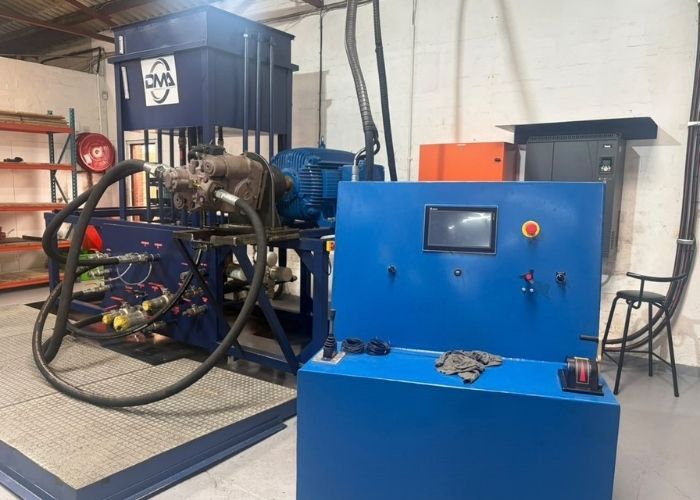
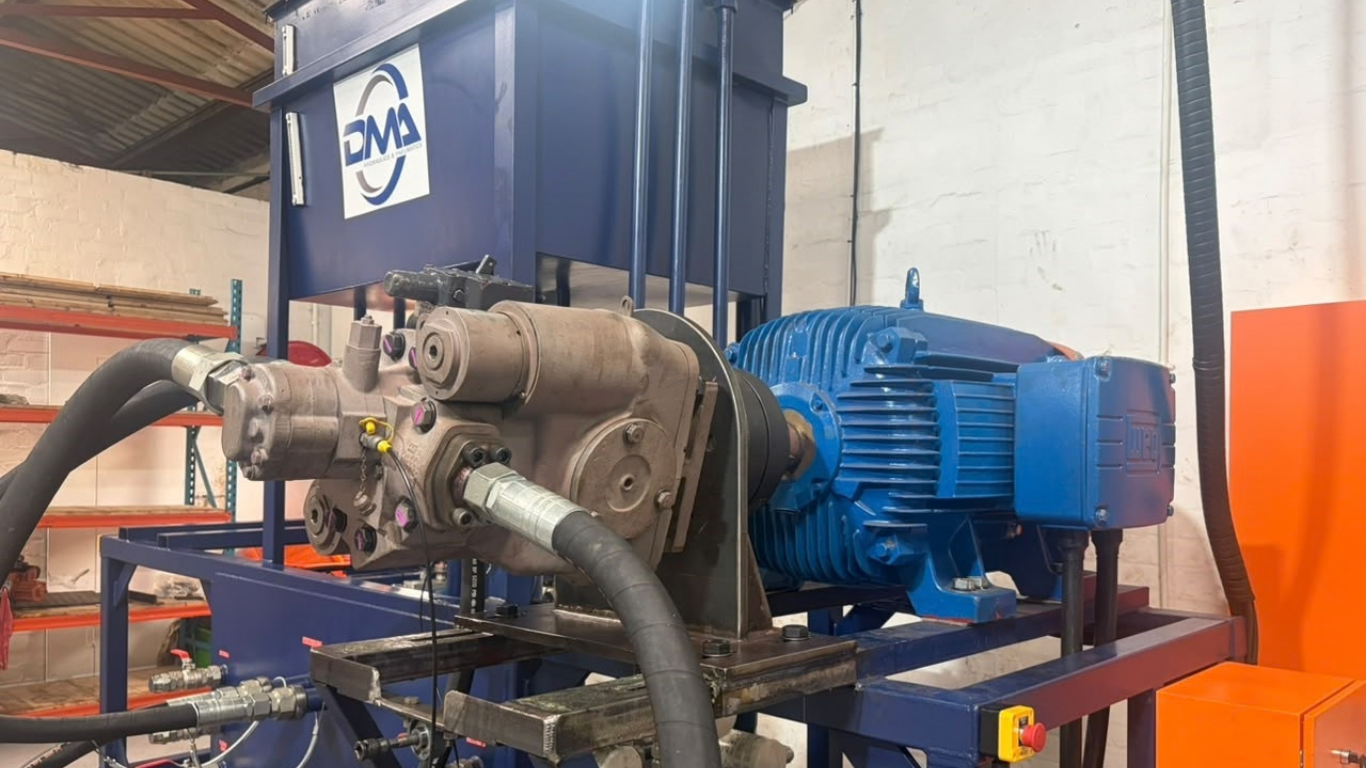
A Sundstrand 27 Series Pump on the DMA Test Rig
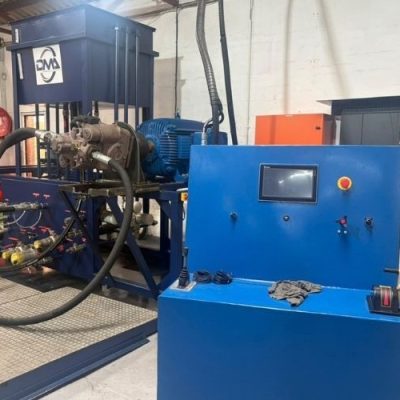
The pump shown in these photographs is a Sundstrand 27 Series pump being tested on DMA’s new hydraulic test rig. Rather than discussing hydraulic testing only in theory, this gives a clear example of the facility doing exactly what it was designed to do: connecting a hydraulic component to a controlled test environment where its operating performance can be measured and analysed.
The test rig is built around a large industrial electric motor and high capacity hydraulic system, with the component physically connected so it can be driven under controlled conditions. The facility has been designed to accommodate the range of hydraulic components DMA encounters across marine, offshore, earthmoving, agricultural, logistics and industrial applications.
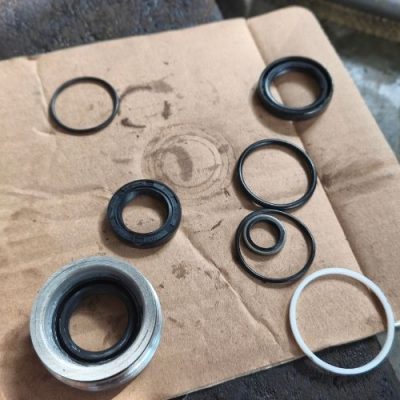
Testing a pump in this environment gives technicians considerably more information than a visual inspection alone. External condition remains important, particularly when assessing connections, shafts, seals and housings, but hydraulic performance is ultimately determined by what the pump delivers when operating. Flow, pressure, speed and the relationship between these measurements provide the information needed to assess that performance.
The important distinction is that testing provides evidence. Instead of relying only on whether a component appears to operate correctly, DMA can observe its behaviour as operating conditions are controlled and changed on the test rig.
Why Hydraulic Pump Testing Goes Beyond Checking Pressure
Pressure is one of the most familiar measurements associated with hydraulic systems, but pressure alone does not provide a complete picture of pump performance. A pump is responsible for producing hydraulic flow, while resistance to that flow creates pressure within the system. Understanding how the pump behaves as those operating conditions change is therefore far more informative than taking a single pressure reading.
DMA’s new testing facility has sufficient capacity to measure maximum pump flow and maximum pressure simultaneously. This allows technicians to analyse how the component performs while it is being subjected to controlled test conditions rather than looking at isolated measurements.
That becomes particularly important when investigating performance loss. A hydraulic pump may still operate and produce pressure while no longer delivering the flow expected from it under demanding conditions. Problems may only become apparent as load increases, operating speed changes or the hydraulic fluid reaches normal working temperature. Controlled testing provides an environment where those changes can be observed without relying on the machine or vessel itself as the primary test platform.
For DMA’s clients, the principle is straightforward. A hydraulic component should not be judged solely on whether it runs. The more important question is whether it produces the hydraulic performance required for the application in which it needs to work.
Precision Speed Control Changes the Quality of the Test
Hydraulic pump performance is closely related to operating speed, which means the speed used during testing matters. Running every component at the same fixed speed would limit how accurately the test conditions represent the component’s intended operation.
DMA’s facility addresses this through a variable frequency drive, or VFD, controlling the large electric drive motor. The VFD allows the test speed to be adjusted precisely so components can be evaluated at an appropriate rotational speed rather than being restricted to one fixed test condition. DMA’s facility information explains that this allows components to be tested at the speeds relevant to their operating specification.
This level of control is particularly valuable because DMA works with hydraulic components from very different applications. A pump removed from earthmoving equipment does not necessarily operate under the same conditions as a component from marine deck machinery or industrial equipment. The ability to control test speed allows the testing process to be adapted to the component rather than forcing every component into the same test parameters.
It also gives technicians an opportunity to observe what happens as operating conditions change. Instead of receiving one snapshot of performance, the component can be monitored through a controlled test process, providing a more useful picture of how it responds.
Real Time Hydraulic Data Shows What Is Happening During the Test
The physical test rig is only one part of DMA’s new facility. The ability to monitor hydraulic performance while a test is taking place is what turns the equipment into a diagnostic and verification tool.
DMA’s test system displays live information through its touchscreen control interface. The facility can monitor hydraulic flow, pressure across multiple measurement points, fluid temperature, rotational speed, electrical current and power consumption. These measurements can be observed while the component operates and while test conditions are changed.
This gives technicians a much clearer view of what is happening inside the test process. Rather than waiting until the component has completed a test and judging the result from a single measurement, changes can be monitored as they happen. Flow can be considered alongside pressure, temperature can be watched as the test progresses and rotational speed can be confirmed against the selected test conditions.
Real time information also supports more informed hydraulic diagnostics. If performance changes as pressure increases or as the component reaches operating temperature, that behaviour becomes part of the technical picture. The purpose is not to collect data simply because the equipment can produce it. The value comes from using measurable performance information to understand the condition and behaviour of the hydraulic component.
Why Fluid Management Matters During Hydraulic Testing
Accurate hydraulic testing depends on more than the pump and drive motor. The hydraulic fluid moving through the test circuit also forms part of the controlled environment, which is why DMA’s facility incorporates dedicated fluid management and filtration technology.
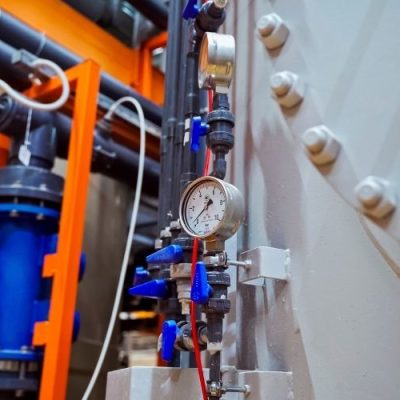
Hydraulic pumps, motors and valves contain precision internal components that depend on suitable fluid conditions for lubrication and operation. Testing a component using contaminated or poorly controlled hydraulic fluid could affect both the component and the reliability of the test itself. DMA’s test facility therefore incorporates a precision valve manifold, filtration and instrumented pipework as part of the fluid management system.
This allows testing to take place within a managed hydraulic circuit rather than treating the fluid merely as the medium needed to make the component operate. Cleanliness, filtration and fluid condition contribute to the repeatability and accuracy of the testing environment.
The same principle matters when a hydraulic component returns to service. A pump that has been repaired and tested should not be installed into a contaminated hydraulic system without addressing the underlying cleanliness problem. Component condition and system condition are closely connected, which is why good hydraulic fault finding considers more than the component that appears to have failed.
What Can Hydraulic Pump Testing Tell DMA?
The value of a test rig lies in the questions it can help technicians answer. Does the pump produce the required flow under the selected test conditions? How does its performance change as pressure increases? Is the component behaving consistently as it approaches normal operating conditions? Are the measured values consistent with the specification or test criteria being used for that particular component?
Those questions are important because hydraulic pump problems do not always present themselves as complete failure. A pump can continue operating while its performance deteriorates. On a machine, that may appear as slower functions, reduced force, inconsistent response or increased operating temperature. In a marine or industrial application, the symptoms may only become obvious when the equipment is placed under sustained load.
Controlled hydraulic pump testing helps separate measurable component performance from assumptions based on symptoms alone. It also gives technicians an opportunity to assess a component away from the other variables present in the complete machine, vessel or industrial system.
Testing does not eliminate the need for proper system diagnostics. A hydraulic problem can originate elsewhere in the circuit, including valves, actuators, filtration, fluid condition, pressure settings or restrictions. What the test rig provides is the ability to evaluate the component itself under controlled conditions and use that information as part of the wider diagnostic or repair process.
Testing After a Hydraulic Pump Rebuild
One of the most valuable applications for DMA’s facility is the testing of hydraulic components following repair or rebuilding. A component can be stripped, inspected and rebuilt in the workshop, but the repair process should ultimately lead to one question: how does the component perform once it is operating again?
DMA’s in house test rig allows hydraulic pumps, motors and control valves to be tested before they are returned to the machine or vessel. The component can be connected, operated under controlled conditions and assessed using live performance measurements. If further adjustment or attention is required, it can be addressed while the component is still in the workshop.
This is particularly valuable where removal and installation require significant time and labour. Discovering a performance problem after a hydraulic pump has already been installed creates additional work and potentially additional downtime. Testing in the workshop adds another verification stage before the component returns to service.
For marine and offshore clients, this can be especially important where vessel schedules and access create tight maintenance windows. For earthmoving operators, a component needs to return to a machine that may be required immediately on site. Industrial clients face similar pressure where hydraulic equipment forms part of a production process. The applications differ, but the benefit of verifying component performance before installation remains the same.
In House Testing Means Greater Control Over the Repair Process
DMA’s decision to bring hydraulic component testing in house changes how the repair process can be managed at its Paarden Eiland workshop. Components no longer need to rely solely on post installation performance as the primary verification step, while appropriate testing can be integrated into the workshop process.
That creates greater continuity between diagnosis, repair, adjustment and testing. If a test indicates that further attention is required, the component is already at DMA’s workshop and can be reassessed before it leaves. Once the required performance has been established, the component can move towards installation with measurable test information behind it.
The capability is also broader than hydraulic pumps. DMA’s facility has been designed for in house testing of hydraulic pumps, hydraulic motors and control valves, giving the company a controlled testing platform across several of the core components it repairs for clients.
DMA also offers testing for components rebuilt elsewhere where a client requires independent performance verification before installation. This extends the value of the facility beyond DMA’s own rebuild work and provides Cape Town operators with access to dedicated hydraulic component testing locally.
Hydraulic Pump Testing Across Marine, Earthmoving and Industrial Applications
Hydraulic pumps perform the same fundamental role of creating flow, but the equipment they serve can be very different. DMA works across marine and offshore operations, earthmoving and construction, agriculture, logistics and transport, and manufacturing and industrial applications. The new testing facility gives these sectors access to the same underlying principle of controlled component verification.
A vessel owner may need confidence in a hydraulic pump before it is returned to deck machinery or another working system. An earthmoving operator may need a rebuilt pump verified before the machine returns to a construction site. A manufacturing operation may depend on a hydraulic power unit delivering the correct performance to keep production equipment working consistently.
These examples also demonstrate why hydraulic testing should not be separated from understanding the application. A useful test needs appropriate operating information and specifications for the component being evaluated. DMA’s ability to combine hydraulic repair experience with its new testing capability means the data can be considered in the context of how the component is expected to work once it returns to service.
Frequently Asked Questions About Hydraulic Pump Testing
What is hydraulic pump testing?
Hydraulic pump testing involves operating a pump under controlled conditions and measuring relevant performance data to assess how the component behaves. Depending on the pump and test requirements, this can include flow, pressure, rotational speed, temperature and other operating information. DMA’s Cape Town testing facility allows flow and pressure to be measured simultaneously while technicians monitor real time hydraulic performance data throughout the test.
Why should a rebuilt hydraulic pump be tested?
A rebuild restores and repairs the physical component, while testing provides an opportunity to evaluate its performance once it is operating again. Testing before installation can identify whether further adjustment or attention is required while the pump is still in the workshop. This is particularly useful where removing and reinstalling a hydraulic pump requires significant labour or where the equipment needs to return to operation quickly.
Can DMA measure hydraulic flow and pressure at the same time?
Yes. DMA’s hydraulic testing facility has been designed to measure maximum pump flow and maximum pressure simultaneously. This allows technicians to consider the relationship between flow and pressure during the test rather than relying on a single isolated measurement. The facility also provides real time information including rotational speed, temperature, current draw and power consumption.
Why is speed control important when testing a hydraulic pump?
Pump output is affected by rotational speed, so controlling test speed is important when assessing hydraulic performance. DMA’s test facility uses a variable frequency drive to control the large electric drive motor, allowing the rotational speed to be adjusted precisely according to the test requirements. This provides greater control over the conditions under which a hydraulic component is evaluated.
What hydraulic components can DMA test?
DMA’s facility has been designed for the in house testing of hydraulic pumps, hydraulic motors and control valves across a range of applications. Because components vary considerably in size, specification and operating requirements, clients with a specific unit should provide the component details to DMA so the team can confirm the appropriate testing requirements and facility capability.
Can DMA test a hydraulic component repaired somewhere else?
Yes. DMA states that components rebuilt by another party can be independently tested at its facility before installation, subject to the component specification and testing requirements. This provides another option for operators who have a repaired hydraulic component but want measurable performance verification before putting it back into a vessel, machine or industrial system.
Where is DMA’s hydraulic testing facility?
DMA Hydraulics’ purpose built testing facility is located at its workshop in Paarden Eiland, Cape Town. The facility forms part of DMA’s wider hydraulic repair and testing capability and supports hydraulic components used across marine, offshore, earthmoving, construction, industrial, agricultural, logistics and transport applications.
Put the Pump to the Test Before It Goes Back to Work
The Sundstrand 27 Series pump shown on DMA’s new test rig is more than a photograph of another piece of hydraulic equipment. It demonstrates what controlled hydraulic testing looks like in practice. The component can be operated at a precisely controlled speed while flow, pressure and other performance information are monitored in real time, giving technicians measurable information about how the pump performs under the selected test conditions.
For DMA Hydraulics and Pneumatic Solutions, the facility strengthens the connection between hydraulic diagnostics, component repairs and performance verification at its Paarden Eiland workshop. Pumps, motors and control valves can now be tested in house, giving DMA greater control over the process before components return to the vessels, machines and industrial systems that depend on them.
If you have a hydraulic pump, motor or control valve that requires repair or performance testing, click the WhatsApp button to speak to the DMA Hydraulics team about the component and the testing requirements.