When a hydraulic pump, motor, or control valve comes off a vessel or a machine for repair, the question every owner needs answered before it goes back into service is simple: does it perform to specification?
Until now, answering that question with complete certainty required either sending components to an external testing facility — adding time, cost, and logistics to every overhaul — or relying on post-installation performance as the verification. Neither is ideal. One delays return to service. The other puts the testing burden on the vessel or machine rather than the workshop.
DMA Hydraulics and Pneumatic Solutions has changed that. We have commissioned a purpose-built, in-house hydraulic testing facility at our Paarden Eiland workshop in Cape Town. Every hydraulic pump, motor, and control valve we rebuild can now be tested on our own rig, under real operating conditions, with live performance data, before it leaves our workshop.
This is what the facility is, how it works, and what it means for every client who brings hydraulic components to us for repair.
What the Facility Consists Of
The testing facility was designed and built to handle the full range of hydraulic components we work with across our client base — from fishing vessel winch motors and offshore pump assemblies to earthmoving equipment pumps and industrial hydraulic power unit components.
The Test Rig and Power Unit
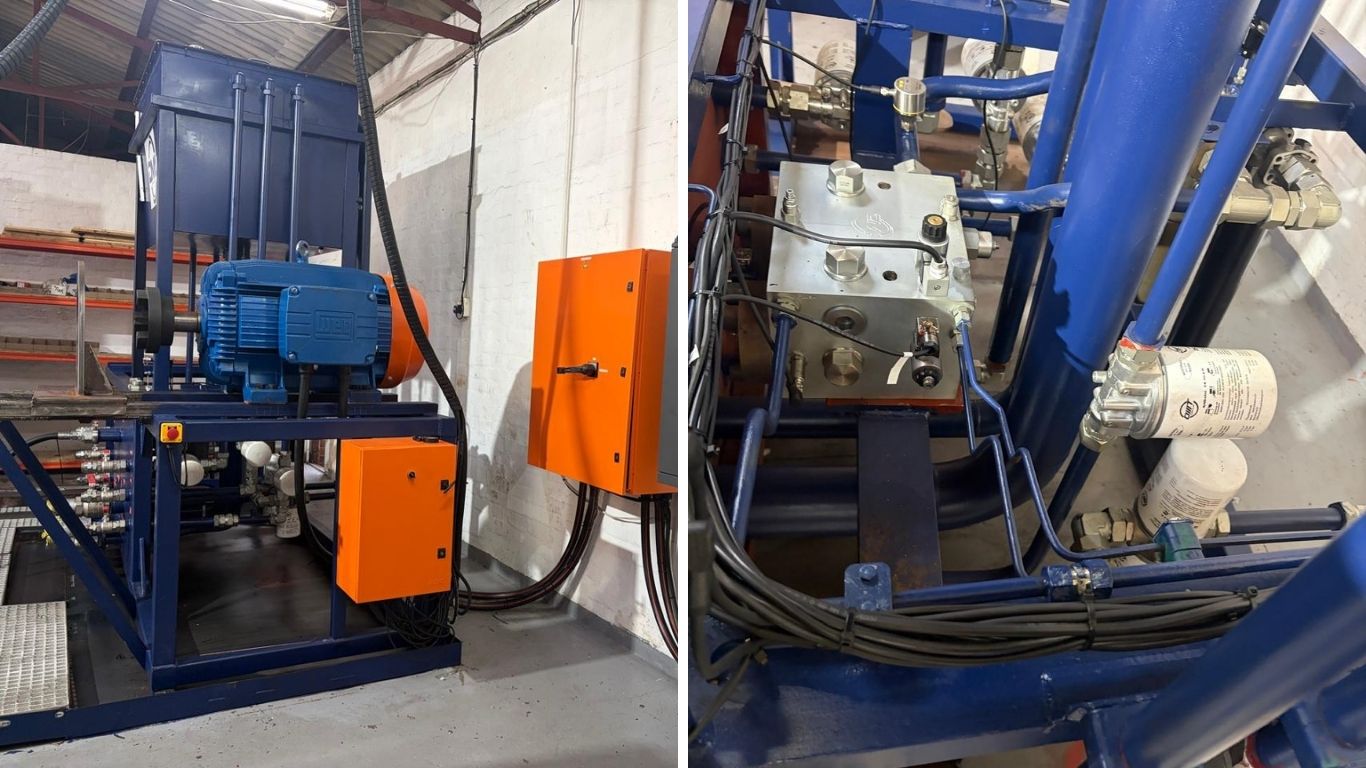
The rig is built around a large industrial electric motor coupled to a high-capacity hydraulic power unit. The DMA-branded reservoir tower, manifold panel, and structural frame were purpose-built for this application. The manifold panel carries clearly labelled suction and pressure ports in multiple sizes, allowing components of different specifications and flow requirements to be connected and tested without adapters or workarounds. The rig has sufficient capacity to measure both maximum pump flow and maximum working pressure simultaneously — which is the only way to accurately map the full performance envelope of a component in a single test run.
Variable Frequency Drive
The electric motor is controlled by a variable frequency drive, or VFD. This is the technical detail that separates a serious test facility from a basic one. A fixed-speed motor can only run a pump or motor at one rotational speed. If that speed does not match the operating speed of the component being tested, the test data does not reflect real-world performance.
The VFD allows us to set the drive motor to exactly the speed at which the component under test normally operates. A marine winch motor that runs at 1,450 RPM in service is tested at 1,450 RPM. An earthmoving pump that operates at 1,800 RPM is tested at 1,800 RPM. The precision of this speed control means the performance data we collect reflects what the component will actually do when it goes back into service — not an approximation.
Real-Time Data and the Control System
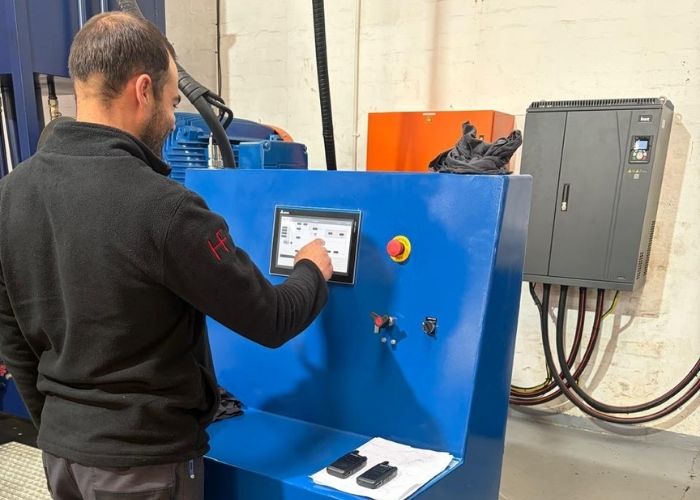
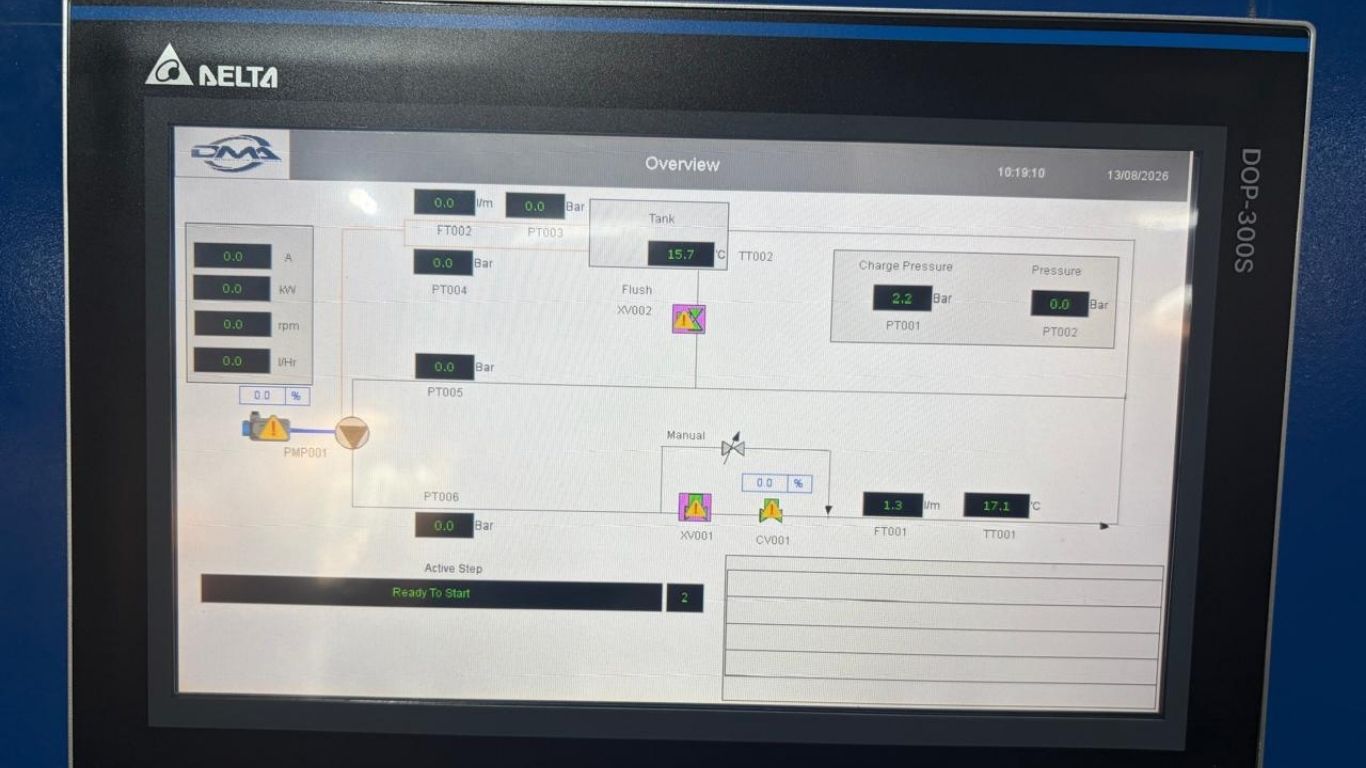
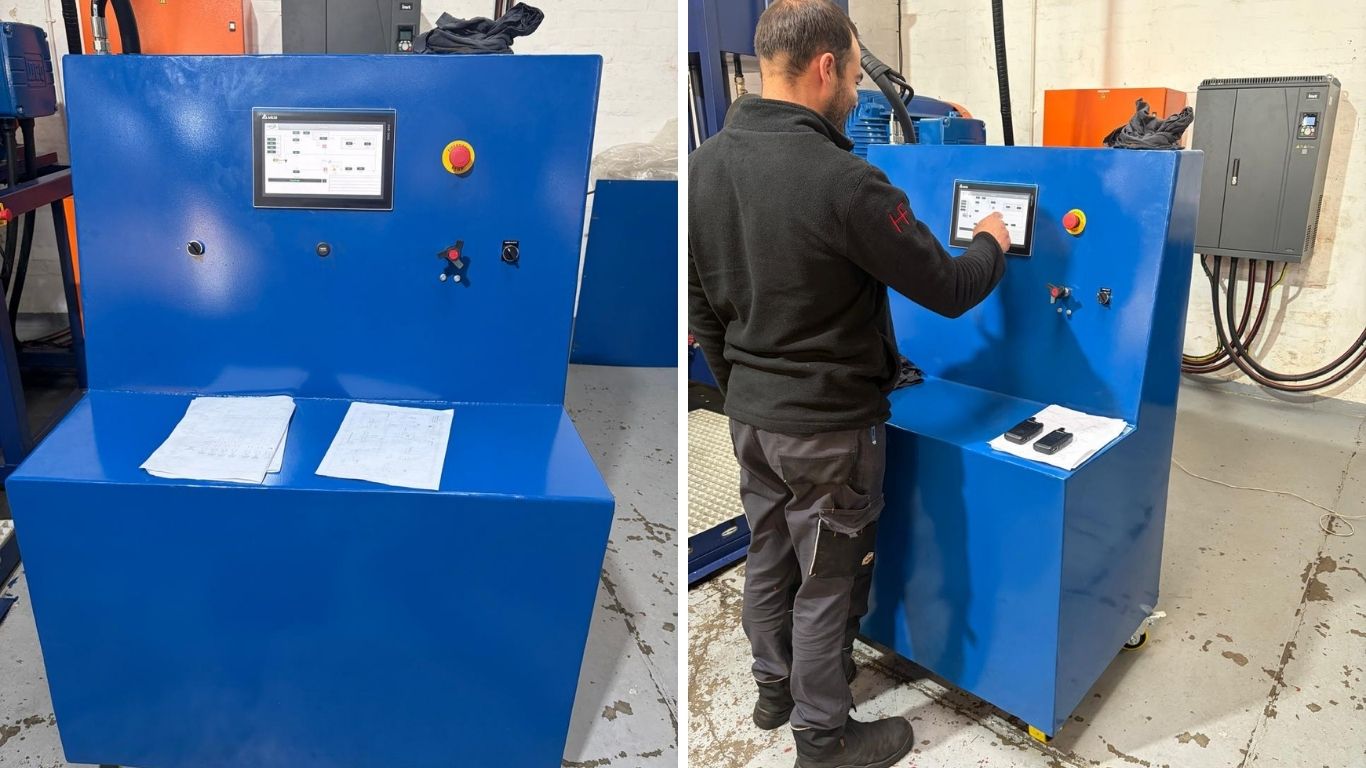
The facility is controlled and monitored through a Delta DOP-300S touchscreen HMI panel. The system displays live readings across multiple data channels simultaneously: flow rate in litres per minute, pressure in bar across six individual pressure transducers, fluid temperature at two measurement points, motor speed in RPM, current draw in amps, and power consumption in kilowatts.
All of this data is visible in real time on the overview screen as the test runs. The technician can observe exactly how the component performs as load is applied, as speed changes, and as the system reaches operating temperature. If a pump is bypassing internally, the flow reading drops against the pressure reading. If a motor is drawing excessive current, the amp reading shows it immediately. If fluid temperature is climbing outside the normal range, it is visible before the test is complete.
This is what real-time hydraulic performance analysis looks like in practice. It is not a pressure gauge and a stopwatch. It is a live, multi-channel picture of exactly how a component is performing at every point in the test.
Fluid Management System
The internal fluid management circuit includes a precision valve manifold block with sensor wiring, dual high-specification filtration units, and instrumented pipework throughout. The fluid system maintains clean, conditioned hydraulic fluid at the correct temperature and cleanliness level throughout every test. Testing a rebuilt component with contaminated or degraded fluid would compromise the test data. The fluid management system ensures the test environment is controlled, repeatable, and consistent across every component that runs on the rig.
FACILITY CAPABILITIES AT A GLANCE
- Speed Control
Variable frequency drive, precise RPM matching to component specification
- Data Monitoring
Real-time flow, pressure at 6 points, temperature, RPM, amps, and kW
- Test Capacity
Maximum pump flow and maximum pressure measured simultaneously
- Fluid Management
Dual high-specification filtration, temperature-controlled, instrumented circuit
- Control Interface
Delta DOP-300S touchscreen HMI with full system overview
- Components Tested
Hydraulic pumps, hydraulic motors, control valves
- Location
DMA Hydraulics workshop, Paarden Eiland, Cape Town
What This Means for Your Components
Before this facility existed, verifying the performance of a rebuilt hydraulic component at DMA required either pressure testing on the vessel or machine after installation, or arranging external testing at a separate facility. Both had limitations.
Post-installation testing on the vessel or machine is impractical as a primary verification step. If the component does not perform correctly, the vessel has already been reassembled and the fault has to be diagnosed in context rather than in isolation. It is also not always possible to load a component to its full operating specification during a dockside test.
External testing added time and cost that affected every client’s turnaround. For a vessel in port with a schedule to keep, or an earthmoving machine that needs to return to a construction site, those delays have a direct operational cost.
In-house testing changes both of those realities. Every rebuilt pump, motor, or control valve now goes on the rig before it goes back into the machine or vessel. It is run at its correct operating speed. Pressure and flow are measured simultaneously against the manufacturer’s specification. Temperature is monitored through to operating conditions. If the component meets specification, we know it before it leaves the workshop. If something needs adjustment or further attention, we address it on the bench rather than after installation.
The result is a rebuilt component that has been verified to perform correctly before it goes back into service. That is a fundamentally higher standard of quality assurance than visual inspection and post-installation testing alone can provide.
Who Benefits from This Capability
Vessel Owners and Chief Engineers
A hydraulic pump or motor that has been rebuilt and tested on our rig arrives on board verified to specification. The chief engineer does not need to accept a component on trust and find out during sea trials whether it performs correctly. The test report from our facility provides objective data that the component meets its designed performance parameters before it is installed.
For vessels on tight port call schedules, in-house testing also reduces overall turnaround time. We do not need to schedule external testing or wait for a third-party facility to be available. The rig is in our workshop. Testing happens as part of the rebuild process.
Earthmoving and Construction Fleet Operators
Hydraulic pumps on excavators, graders, and TLBs are expensive components. A pump that is rebuilt incorrectly or that has an undetected internal fault will fail again in service. Testing the pump on our rig before it goes back into the machine confirms the rebuild is correct and gives the fleet operator confidence that the machine will perform as expected when it returns to the construction site.
Industrial and Manufacturing Clients
For hydraulic power units, press systems, and production line hydraulics, component performance within specification is not optional. A pump that is not delivering correct flow or pressure affects production quality as well as production rate. In-house testing allows us to verify that rebuilt components meet the precise specifications that industrial applications demand.
Agricultural and Logistics Operators
Seasonal agricultural operations and transport fleets cannot afford the time delay of sending components to external test facilities. In-house testing at DMA means rebuilt hydraulic components can be verified and returned to service faster, with no compromise on the quality of the verification.
Frequently Asked Questions
What components can be tested on the DMA hydraulic test facility?
The facility is designed to test hydraulic pumps, hydraulic motors, and control valves across a wide range of sizes and specifications. If you have a specific component and want to confirm it falls within our testing capability, contact our team before bringing it in.
What data does DMA provide after a component test?
Our test system captures real-time flow, pressure at multiple points, fluid temperature, motor speed, current draw, and power consumption throughout the test. We can provide this performance data to clients who need documented verification that a component meets specification before installation.
Does testing add time to a repair turnaround?
Testing is integrated into the rebuild process rather than added on top of it. In most cases it reduces overall turnaround time compared to our previous process, because we no longer need to arrange external testing. The rig is in our workshop and testing is scheduled as part of the job.
Can you test components that were rebuilt elsewhere?
Yes. If you have a component that was rebuilt by another party and you want it independently verified before installation, we can test it on our facility. Contact our team to discuss the component specification and arrange a test booking.
Is the testing facility available to clients in all industries?
Yes. The facility supports all industries we work in — marine, offshore, earthmoving, agriculture, logistics, transport, and manufacturing and industrial operations.
Where is the testing facility located?
The facility is at our workshop in Paarden Eiland, Cape Town. Components can be brought to us or collected by arrangement, and we can discuss logistics for marine components arriving with vessels in port.
A Higher Standard of Verification — Right Here in Cape Town
Every hydraulic pump, motor, and control valve we rebuild now goes through our in-house test facility before it goes back into service. That is the standard we have set for ourselves, and it is the standard every client benefits from.
If you have hydraulic components that need repair and testing, or if you want components tested independently before installation, contact DMA Hydraulics and Pneumatic Solutions. We are based in Paarden Eiland, Cape Town, and our new testing facility is ready to work.
Call us or send a WhatsApp to discuss your requirements